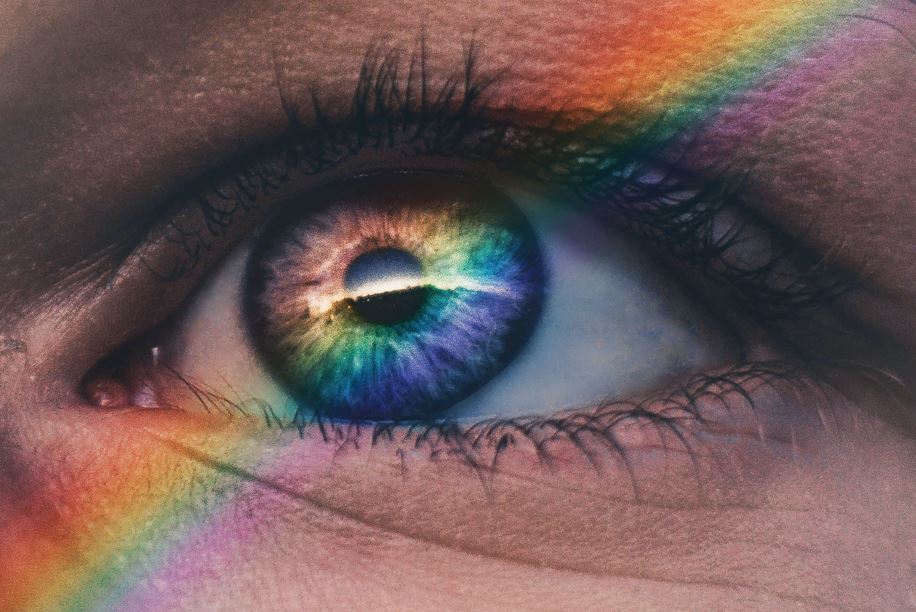
What does your eye colour say about you and your eye health?
Why do we all have different eye colours?
Eye colour is an amazingly unpredictable thing. Two brown eyed parents can have a green eyed child (eye colour can be influenced by as many as 16 different genes!), a baby born with blue eyes may become brown eyed two weeks later, and certain eye conditions can cause your eye colour to change later in life. We’re going to look into which personality traits are typically associated with various eye colours, as well as what iris hues can mean for your susceptibility for different eye conditions.
First things first, it’s important to understand why people have different eye colours, and it all comes down to one word: melanin. Melanin is the pigment that is present in your eyes and it is spread across two layers of your iris. If you have more melanin on the back layer of your iris, you will have dark brown eyes. If you have a smaller amount of melanin on the front of your iris, your eyes will be lighter in colour, appearing blue, green or hazel. Essentially, the more pigment you have, the darker your eyes will be. Most babies are born with a very small amount of melanin which develops over their first six months of life, often resulting in blue eyes turning brown! A child’s eye colour is fully developed by the age of 3.
It is thought that blue eyes first occurred between 6,000-10,000 years ago as a result of a genetic mutation. Researchers believe that the mutation occurred in Europe and caused blue eyes by limiting the production of melanin in the iris. 48% of the British population are blue eyed while brown eyed people only make up 22% of the population here, with the rest of the total being covered by green or grey eyes. Globally, eye colour distribution varies significantly to that of just the UK, with 90% of people around the world having some shade of brown eyes, 8% with blue eyes, and 2% with green eyes.
Ultraviolet rays and age-related macular degeneration
The sun emits UV rays which are known to damage your eyes. We’ve written about this previously on the blog and have covered how you can protect your eye health and prevent the onset of eye conditions brought on by UV ray exposure. One of the most common eye conditions associated with exposure to the sun is age-related macular degeneration (AMD). AMD is actually one of the UK’s leading causes of sight loss. It affects your central vision which begins to deteriorate, first as blurry vision before progressing into blank spots in the middle of your visual field. If you have light coloured eyes, your risk of developing AMD is actually twice as high as someone with dark eyes.
This is because AMD is brought on by exposing your eyes to too much UV light and, as light eyes – such as blue, green and grey – have less melanin in them, they are more susceptible to sun damage. UV rays can be blocked more effectively by the extra melanin in darker eyes, possibly lowering the risk of developing AMD.
Can cataract risk be associated with eye colour?
Cataracts form as a natural part of the ageing process when proteins in your eye begin to clump together. This causes cloudy vision and, if left untreated over a number of years, this can impair vision so severely that it leads to total blindness. Over 20 million people worldwide have experienced vision loss as a result of cataracts. Research from the American Journal of Ophthalmology has found a link between eye colour and susceptibility to developing cataracts: if you have brown eyes, you are 1.5-2.5 times more likely to experience cataracts.
However, how much of this relates to eye colour, and how much relates to hereditary characteristics? We inherit both our eye colour and tendency to develop cataracts, so what if the cataract-prone genes are being passed on from our parents, just as our eye colour is? Although people with brown eyes have a higher risk of developing cataracts, they have a lower risk of eye cancer, diabetic retinopathy, and AMD.
Does your eye colour relate to personality traits?
Some of the biggest myths around eye colour relate to specific traits or qualities which people attribute to those with various eye colours. Studies have shown that people with brown eyes were perceived as the most trustworthy, although this was only based on the opinions of 238 participants who looked at and rated photos of people.
In a separate study of personality traits versus eye colour, brown eyed participants described themselves as more outgoing than blue eyed participants did. Blue eyed participants were generally “less agreeable and more competitive”, which would fit well with the theory of the gene mutation 6,000-10,000 years ago. The belief is that this pattern may have led to blue eyed people having a “competitive edge”, carrying down in genes to the generations of today.
What if your eye colour changes?
If you experience a change in your eye colour, it’s important to get your eyes checked as it can be a symptom of a number of eye conditions, such as:
- Glaucoma
- Pigment dispersion syndrome
- Diabetes
- Iris tumours
- Eye injuries
Some people with green or hazel eyes may experience something called Rayleigh scattering, which is a term to describe “the way light scatters after riding its spectrum wavelength.” This is why it might appear that green and hazel eyes change shades from day to day – or even hour to hour – but this phenomenon is not the same as the drastic eye colour changes caused by the conditions list above. Visit your optician if you have any questions about your eye health.
If you enjoyed this blog post, you might also like:
Heterochromia: Why do some people have different coloured eyes?